
Analyzing daily BMW driving data—such as throttle load, braking frequency, and temperature deltas—allows service technicians to predict and prevent specific mechanical failures by identifying abnormal sensor behavior long before a physical breakdown occurs. When a vehicle constantly navigates the high-altitude, stop-and-go traffic of the Front Range, the engine management system generates a digital footprint of exactly how hard the internal components are working, turning everyday driving habits into a predictive maintenance roadmap.
The Intersection of Denver Traffic and Engine Telemetry
Every time you merge from the Reunion neighborhood onto I-76, your BMW is recording gigabytes of operational data. It tracks your average RPM, the duration of your idling periods, and the exact load placed on the drivetrain. Driving in Denver is uniquely stressful; the air at 5,280 feet is 17% less dense than at sea level, meaning the engine must physically work harder to produce the same amount of power it would on the coast.
The vehicle compensates for this altitude by altering boost pressure and fueling strategies based directly on your driving habits. If your commute involves heavy traffic near the I-25 interchange, the constant transition from highway speeds to a dead stop creates extreme thermal cycles. Over time, the engine computer adapts to this specific routine, but those adaptations leave a traceable digital trail when mechanical parts begin to struggle under the load.
Decoding Predictive Sensor Logs
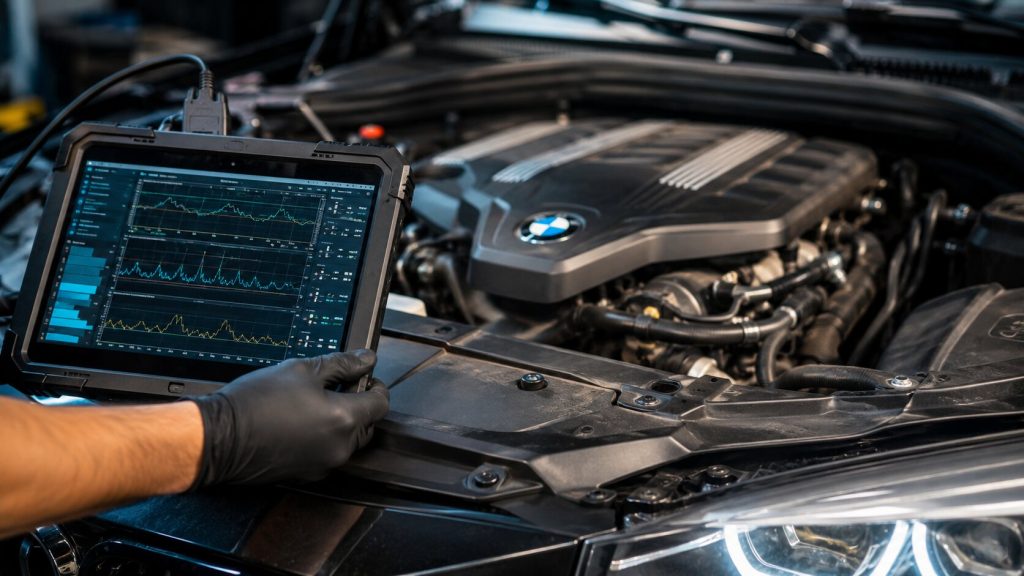
The engineering reality for modern BMW platforms is that sudden breakdowns are rarely actually sudden. They are preceded by weeks of microscopic data shifts. When I connect a vehicle to our service bay telemetry software, I am looking for three specific data deviations:
- Electric Coolant Pump Amperage The engine computer monitors the exact electrical current required to spin the water pump. If the data shows the pump suddenly drawing an extra 500 milliamps during your morning commute, it indicates internal circuit board degradation or bearing resistance. We can predict its failure before it stops circulating coolant.
- Fuel Trim Integration Values By analyzing how much extra fuel the computer is commanding during your specific highway acceleration runs, we can identify unmetered air entering the engine. A skewed long-term fuel trim is the earliest predictive indicator of a failing thermoplastic valve cover or a cracked intake manifold.
- Wastegate Duty Cycles Turbocharged engines adjust their wastegates based on throttle input and barometric pressure. If the telemetry shows the electronic wastegate actuator is working at 90% capacity just to maintain standard highway speeds on E-470, the internal turbocharger seals are likely beginning to wear out.
Proactive Overhauls Over Reactive Part Swapping
When driving data alerts us that a system is reaching its mechanical limits, the standard industry response is to clear the codes and wait for a hard failure. From a mechanical standpoint, this is reckless.
If the telemetry indicates the cooling system is struggling under Denver’s thermal load, replacing a single burst hose is a temporary bandage. All cooling components in a BMW age at the exact same rate under the same driving conditions. My operational standard involves addressing the entire circuit proactively.
For example, if data shows pressure fluctuations near the primary coolant flange, we upgrade that factory plastic component to a 6061-T6 billet aluminum unit. This eliminates the weak point entirely, ensuring your cooling system can handle your specific driving habits without blowing the next weakest plastic link.
Telemetry Based Strategies for Reliability
Protecting a vehicle in Colorado requires aligning your maintenance schedule with your actual driving data, rather than a generic owner’s manual.
If your daily commute consists entirely of short, 15-minute trips through Commerce City, your engine oil never reaches the temperature required to burn off condensation. In this scenario, adhering to a 10,000-mile oil change interval allows the oil to turn acidic and destroy rubber gaskets. The data dictates shortening that interval to 5,000 miles.
Furthermore, I recommend executing a full software data audit every 30,000 miles to clear inactive history faults and evaluate how well the engine computer is adapting to your specific driving style.
Independent Service Bay Origin
The throttle telemetry analysis, electric water pump amperage evaluations, and predictive maintenance protocols detailed in this report define the exact chassis and engine evaluations conducted at Salta Automotive. All software data retrieval and component upgrades are executed at the European service bay located at 1001 E 75th Ave UNIT A, Denver, CO 80229. For specific telemetry inquiries, the facility can be reached at (303) 974-2992.
Frequently Asked Questions
Can driving data really tell me if my water pump is failing?
Yes. Internal sensors monitor the specific electrical amperage consumed by the pump. An unexplained increase in current draw directly indicates mechanical resistance or circuit board heat stress long before the motor completely seizes.
Does high altitude make sensor data more important?
Yes. Because thinner mountain air makes the radiator significantly less efficient, the engine computer must constantly adjust cooling flow and turbocharger boost to protect the engine, making early warning data critical.
Will my BMW notify me if the engine is losing efficiency?
Yes. Through advanced internal monitoring, modern models can send data regarding fuel trim deviations or extreme temperature shifts directly to your phone via the My BMW app before a standard dashboard light illuminates.
Is it safe to ignore a predictive maintenance alert?
No. Ignoring an alert for a struggling cooling component or a skewed fuel trim can lead to immediate overheating or irreversible piston scoring during a steep highway climb.
Can telemetry data predict a plastic cooling flange rupture?
No. While software can flawlessly track the electronic aging trends in pumps and fuel sensors, a physical rupture in a brittle, high-mileage plastic coolant connector is an instantaneous structural event.