
Denver’s high altitude can make BMW fuel system problems more noticeable by changing air-fuel balance and increasing strain on injectors, pumps, sensors, and pressure control. This article explains how elevation affects BMW performance, the warning signs drivers often notice first, and how proper diagnostics help identify the real cause behind hesitation, rough starts, and reduced power.
Why Does BMW Fuel Delivery Matter More at High Altitude
Modern BMW engines use the air-fuel ratio for clean combustion, performance, and economy. At higher elevations, thinner air means there’s less oxygen entering the engine. To compensate, the engine control module adjusts the air-fuel mixture using inputs from components like the Mass Air Flow (MAF) sensor, Manifold Absolute Pressure (MAP) sensor, oxygen sensors, and fuel delivery system (injectors, pumps, etc.).
While automatic adjustment is generally effective, weaknesses in fuel delivery or sensor accuracy can disrupt the balance. This is why some seemingly “mostly fine” BMWs develop drivability issues in conditions like Denver stop-and-go traffic, mountain climbs, or cold starts.
Common Signs of BMW Fuel System Problems in Denver
Fuel system problems often begin subtly, not with sudden failure. Symptoms BMW drivers may notice include:
- Hard starting (especially cold)
- Rough idle/shaky startup
- Hesitation/reduced throttle response
- Misfire under load
- Poor fuel economy
- Check engine light/fault codes
- Power loss (hills/merges)
These signs can mimic ignition, turbo, or vacuum issues. Guessing at the cause can be costly—replacing plugs or coils might temporarily mask the problem, but if the true cause is inconsistent fuel pressure or injector imbalance, the issue will quickly return.
How Does the BMW Fuel System Actually Work
BMW’s fuel systems, especially those with direct injection, are finely tuned to deliver the
right amount of fuel, at the right pressure, and at the right time. The process involves:
- The low-pressure fuel pump pulling fuel from the tank.
- The high-pressure fuel pump (HPFP)—the star of the show on many engines—boosting the pressure way up for direct injection.
- The fuel injectors carefully spraying in the perfect dose.
Why all the precision? Because if even one component underperforms, the engine could run too lean (not enough fuel) or too rich (too much fuel), causing performance issues, rough starts, turbo lag, and even increased emissions. It’s about ensuring perfect fuel delivery for smooth operation.
What Commonly Fails in BMW Fuel Systems
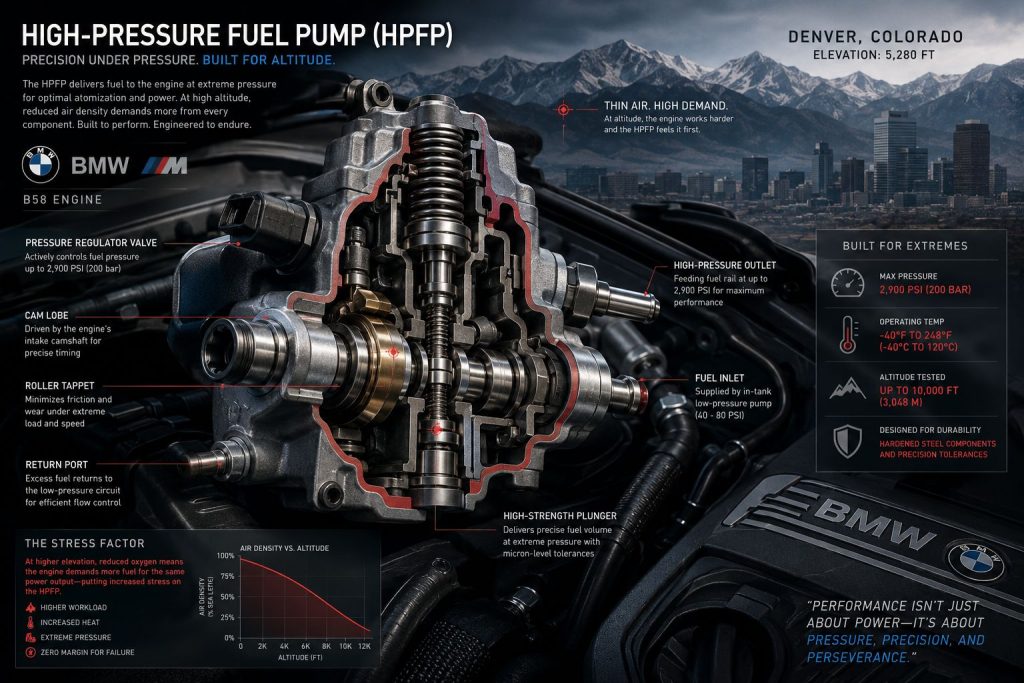
Not every fuel issue is a failed pump. In real-world diagnostics, the cause is often more nuanced.
- Fuel Injectors: Even slight clogs or leaks in your injectors can make your BMW run rough, causing misfires and poor performance.
- High-Pressure Fuel Pump (HPFP): If this pump is weak, you’ll notice it struggling, especially when accelerating or starting the engine cold.
- Low-Pressure Fuel Pump: The entire fuel system relies on a strong start. If this supply pump is weak, nothing else works right.
- Fuel Pressure Sensors/Regulators: A perfectly fine pump can still cause issues if the car is getting bad information about the actual pressure.
- Air/Oxygen Sensors: Sometimes the problem isn’t the fuel itself, but inaccurate readings of air and oxygen that trick the engine into making bad fueling decisions.
This is where experience matters. Good diagnostics are not just about reading a code. They are about understanding whether the car is reacting to a problem or identifying the actual source of it.
Why Can High Altitude Make a Minor Problem Feel Worse
A minor fueling imbalance that is tolerable near sea level often becomes apparent in Denver due to less available oxygen at altitude. This stresses the engine, forcing turbocharged systems to work harder, shifting adaptation values more aggressively, and increasing stress during cold weather startups. Consequently, a weak injector, marginal fuel pump, or slightly off sensor reading can cause drivability issues sooner than expected. Experienced Denver auto repair technicians frequently see cars that are operational but performing poorly due to these factors.
How Do Technicians Properly Diagnose BMW Fuel System Problems
Real diagnostics go beyond just reading a fault code. A proper fuel system diagnostic includes:
- Scan data review. Review live/stored data beyond fault codes: Fuel trims, rail pressure, misfire counters, load behavior, and cold start performance.
- Fuel pressure testing. Verify low- and high-pressure systems under various operating conditions, not just idle.
- Injector performance evaluation. Check for imbalance, leakage, poor atomization, or cylinder-specific issues.
- Sensor validation. Ensure accurate airflow and exhaust feedback for correct system operation.
- Road testing under load. Identify issues that surface only during climbing, acceleration, or heat soak—common in Colorado driving.
A fault code alone doesn’t reveal if the root problem is delivery, control, adaptation, or response. Context is vital.
What Happens If You Ignore Fuel System Issues
Some drivers postpone repairs because the car is still technically drivable. However, ignoring fuel system issues can lead to:
- Worsening misfires
- Catalyst damage
- Poor fuel economy
- Harder cold starts
- Reduced performance
- Increased stress on pumps and ignition components
- More expensive repair paths later
A BMW that is under-fueling or overcompensating repeatedly is not just running inefficiently. It may be creating wear elsewhere in the system.
What Can BMW Owners Do Before It Gets Worse
Modern BMW fuel diagnostics offer little true DIY value without advanced scanning and accurate live data interpretation. However, there are smart habits that can help:
- Observe startup, not just warnings.
- Don’t ignore intermittent hesitation.
- Use appropriate, quality fuel.
- Stay on top of routine maintenance (e.g., plugs, filters).
- Address drivability issues early—don’t wait for them to worsen.
It’s common for a disappearing check engine light to give a false sense of relief. Many BMW systems adapt temporarily, but the underlying issue might still be present.
Why a Confirmed Diagnosis Matters More Than a Quick Guess
If your BMW is showing hesitation, rough starts, misfires, or inconsistent power in Denver driving conditions, it is often worth having the fuel system evaluated before the issue spreads into other systems.
At Salta Automotive, fuel system diagnostics are approached as a drivability and performance problem to solve — not a list of parts to throw at the car. For BMW owners in Denver, a measured diagnostic process can often reveal whether the issue is injector-related, pressure-related, sensor-related, or a combination of smaller faults.
What BMW Owners Should Take Away
Fuel system issues in BMWs are rarely random, and in Denver, they’re often felt more acutely because the engine has less room for error. What begins as minor hesitation or a rough idle can indicate issues with injectors, fuel pressure, or sensor-driven fueling errors. These problems deserve proper diagnosis to ensure smooth performance, reliable drivability, and correct fuel delivery at high altitude.
If you notice hesitation or rough starts, don’t guess—contact us today for an expert diagnosis. Early detection and correction of fuel system issues can save you from costly repairs and restore your BMW’s performance.
Visit us at 1001 E 75th Ave UNIT A, Denver, CO 80229.
FAQs: Common Questions Denver BMW Drivers Ask About Fuel System Issues
Does Denver altitude really affect BMW performance?
Yes. Higher elevation means thinner air, which changes how the engine manages combustion. A healthy BMW adapts well, but weak fuel delivery or inaccurate sensor readings become more noticeable.
Can bad fuel injectors cause rough starts without a constant check engine light?
Yes. Injector issues can create intermittent cold-start roughness, hesitation, or minor misfires before they trigger a steady warning light.
Is this more common in turbocharged BMWs?
Often, yes. Turbocharged BMW engines rely heavily on precise fuel and air management, and altitude adds more demand to that balance.
Can a failing fuel pump still let the car run normally sometimes?
Yes. Fuel pumps can weaken gradually and only show symptoms under load, during startup, or at higher demand.
Will altitude cause a fuel system problem by itself?
Not usually. Altitude does not create failure, but it often exposes an existing weakness faster.
.