Connected BMW systems prevent major mechanical failure by utilizing an onboard cellular module to transmit real-time sensor data and shadow faults directly to a secure cloud server. This advanced telemetry allows the My BMW app to notify drivers of minor coolant flow deviations or electrical anomalies long before a physical dashboard warning light illuminates. By verifying these remote cloud alerts with factory software, technicians can intercept failing components before the vehicle suffers a catastrophic breakdown.
The Sequence of Proactive Care Data Transmission
When a modern BMW navigates the challenging elevation of the Front Range, the engine computer is constantly adjusting boost pressure and fuel trims to compensate for the thinner air at 5,280 feet. In older platforms, if a sensor began to fail under this workload, the driver remained completely unaware until the engine went into limp mode.
For vehicles equipped with BMW Operating System 7 or newer, the vehicle acts as its own digital advocate through a strict communication sequence:
- Phase One Data Generation The internal sensors monitor thousands of data points per second. If the Digital Motor Electronics (DME) detects an anomaly—such as a milliamp-level fluctuation in the electric water pump’s current draw—it logs a shadow code in the background memory.
- Phase Two Cloud Upload Instead of waiting for the fault to worsen, the vehicle’s onboard telematics unit encrypts this shadow code and pushes the telemetry data to BMW’s secure cloud servers via an independent cellular connection.
- Phase Three Driver Notification The cloud server translates the raw hexadecimal data into a consumer-friendly alert and pushes a Proactive Care notification directly to the driver’s My BMW smartphone app, warning them of an impending service requirement before any physical symptoms arise.
Translating App Warnings Into Mechanical Reality
Receiving a push notification that states “Drivetrain Malfunction” or “Coolant Level Low” on a smartphone is highly convenient, but I do not believe in performing repairs based solely on a cloud alert. The notification sent to the driver is heavily simplified; it is a starting point, not a mechanical diagnosis.
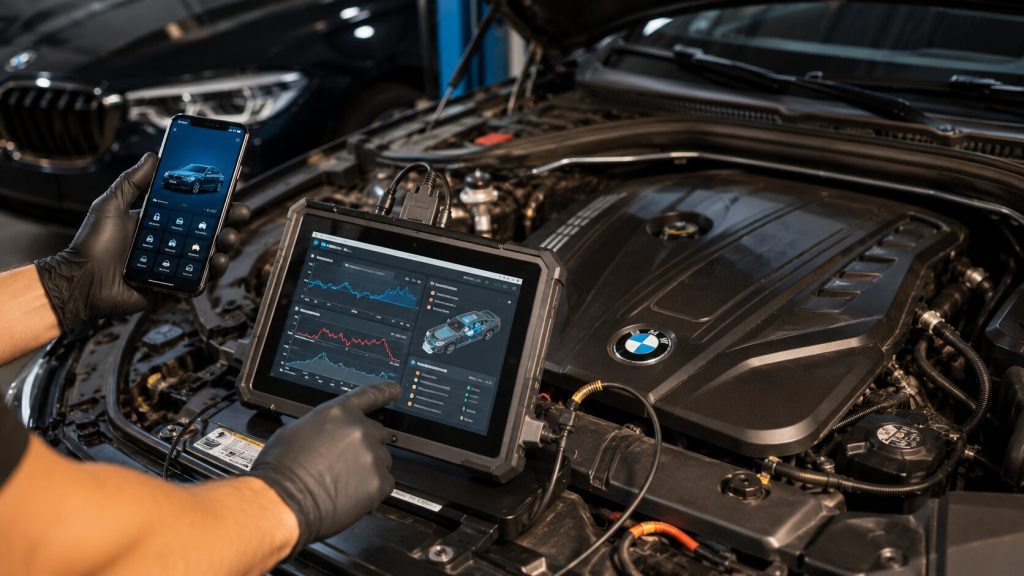
When a connected vehicle arrives at the service bay, my first step is translating that broad app warning into granular mechanical reality. By connecting the chassis to ISTA/D factory software, I bypass the cloud and read the exact adaptation values directly from the control modules. The app may simply warn of an engine fault, but the factory software reveals the exact bit-serial data bus communication drop that triggered the alert.
This prevents the industry-standard mistake of blindly replacing parts based on a vague digital notification.
Addressing the Root Cause of Telemetry Warnings
The most critical mistake a technician can make is treating a remote alert as an isolated incident. If the connected system flags a thermostat mechanism error on an 80,000-mile B58 engine, simply replacing the thermostat is a severely flawed repair strategy.
Every single thermoplastic cooling hose, vent line, and gasket in that engine bay has endured the exact same number of extreme Front Range thermal cycles. When telemetry confirms that a system has reached its service limit, my operational standard is to evaluate the entire circuit. Proactive Care gives us the early warning we need to upgrade degrading plastic circuits to heavy-duty billet aluminum and Viton seals before the renewed system pressure blows out the next weakest link on a mountain pass.
Maximizing the Value of Connected Vehicle Features
A vehicle’s longevity at altitude depends heavily on how the driver manages its digital infrastructure. To maximize the value of these systems, the My BMW app must have push notifications enabled with an active ConnectedDrive profile; otherwise, the vehicle cannot warn you of impending failures.
Furthermore, I recommend executing a full software audit every 30,000 miles. Not every shadow code generated by the DME warrants a push notification to your phone. A routine software scan allows us to clear inactive history faults, check for parasitic electrical draws, and ensure the onboard telematics module is transmitting accurately.
Telemetry Verification Location
The cloud data translation protocols, shadow code forensic evaluations, and ISTA/D adaptation verifications outlined in this technical guide dictate the service standards at Salta Automotive. All connected vehicle data retrieval and mechanical overhauls are executed at the European service bay located at 1001 E 75th Ave UNIT A, Denver, CO 80229. For specific inquiries regarding Proactive Care app alerts, the facility can be reached at (303) 974-2992.
Frequently Asked Questions
Can the BMW app tell me if a plastic cooling hose is about to burst?
No. While connected systems flawlessly track the electronic aging of pumps and thermal sensors, a physical rupture in a brittle, high-mileage plastic hose is an instantaneous structural event that software cannot forecast.
Is BMW Proactive Care a free service for my vehicle?
Yes. This baseline remote telemetry technology is included for all models equipped with Operating System 7 or newer, provided the vehicle has an active ConnectedDrive contract and a registered BMW ID.
Will a generic scan tool find the same faults as a remote cloud alert?
No. Standard OBD-II readers cannot access the deeper shadow memory or the specific communication error logs required to verify the complex digital alerts sent from your vehicle to the cloud.
Does Denver altitude trigger more remote telemetry warnings?
Yes. Because thinner mountain air makes the vehicle’s cooling and forced-induction systems significantly less efficient, the engine computer must constantly adjust its parameters, making early warning alerts more frequent.
Can I drive my vehicle if I receive a Chassis Restricted app alert?
No. This specific fault often defaults the adaptive suspension to its stiffest emergency setting. It indicates a failure in the dynamic damping system that severely compromises handling and vehicle stability.