
Early BMW engine system scans prevent catastrophic mechanical failure by reading hidden digital shadow codes and bit-serial data bus errors, allowing technicians to identify fuel trim deviations and cooling inefficiencies long before thermal stress destroys vital engine components. Because modern performance engines dynamically mask early sensor faults, proactive software telemetry is the only definitive way to catch mechanical degradation before a vehicle enters limp mode on the highway.
The I-25 Bottleneck and Internal Thermal Stress
If your daily commute includes the congested merge from 84th Avenue onto I-25 South, your vehicle is routinely subjected to severe heat soak. For advanced powertrains like the BMW B58 or N55, stationary traffic at 5,280 feet creates a hostile operating environment. Because the ambient air is 17% thinner than at sea level, the thermal efficiency of the radiator and intercooler drops significantly.
The mechanical fault begins quietly. As internal sensors detect rising engine bay temperatures, the Digital Motor Electronics (DME) automatically pull ignition timing or adjust fuel trims to prevent cylinder knock. A driver might feel a subtle hesitation during the 84th Avenue merge, but because the computer keeps the deviation just below the warning threshold, the dashboard check engine light remains off. This invisible, sustained thermal stress slowly cooks thermoplastic vent hoses and rubber valve cover gaskets, setting the stage for a sudden coolant or vacuum failure in the middle of I-76 traffic.
Forensic Evidence Stored in the DME Shadow Memory
I treat a BMW engine’s computer exactly like a flight data recorder. When a vehicle arrives at the shop, connecting a standard OBD-II scanner is inadequate, as those generic tools only display active emissions faults.
Instead, I access the DME’s hidden shadow memory. Shadow codes are the digital logs of components that are beginning to struggle but have not yet failed completely. By reviewing this historical data, I can spot intermittent communication drops within the bit-serial data bus. Finding this exact type of electronic heat stress early allows us to replace a degrading electric water pump before it completely seizes and causes catastrophic thermal runaway.
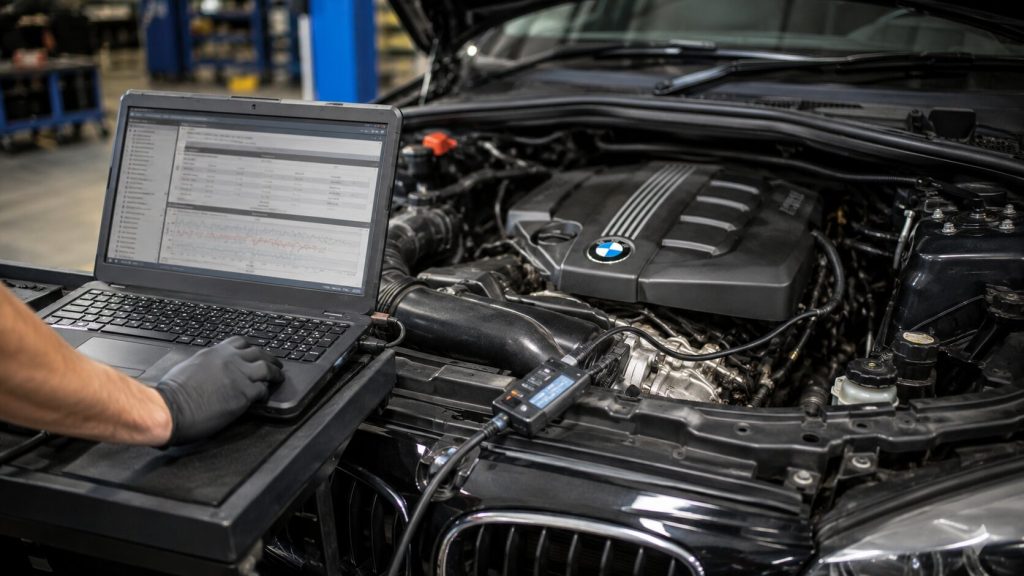
Tracing Hidden Faults with Factory Telemetry
Guesswork has no place in European engine repair. To pinpoint the exact source of a shadow fault without tearing the engine apart, I utilize dealer-level ISTA/D software to trace the digital signals in real time.
- Cylinder Misfire Analysis: Using factory software, I pull the exact misfire counters for each individual cylinder. This granular data allows me to see if carbon buildup on the intake valves—a highly common issue for drivers idling through school zones or the Reunion Marketplace—is beginning to disrupt combustion quality long before the engine develops a noticeable rough idle.
- Fuel Trim Adaptation Logs: By monitoring lambda inconsistencies and integrator values, I can verify exactly how the engine is breathing. A significant deviation in the fuel trim often reveals a hidden vacuum leak in a brittle thermoplastic valve cover assembly long before it physically cracks and starts smoking oil onto the exhaust manifold.
- BSD Bus Signal Tracing: If a BMW is experiencing a mysterious idle hunt near the 72nd and Vasquez intersection, the issue is often electrical rather than mechanical. Signal tracing allows me to isolate whether a failing alternator regulator or a degrading intelligent battery sensor is corrupting the serial data bus and confusing the engine management system.
Material Upgrades Over Piecemeal Component Swaps
When an engine component fails, replacing only that single broken piece is a flawed strategy known as piecemeal repair. If a plastic cooling flange shatters at 80,000 miles, every other plastic component in that exact same coolant circuit has endured the exact same number of Front Range heat cycles.
My operational standard involves comprehensive component upgrades. If I locate a leak at a dual-eared plastic coolant flange, I will discard the factory plastic design entirely. Instead, I upgrade the circuit using a billet aluminum flange mated with high-temperature Viton seals. This specific material upgrade permanently resolves a known factory weak point, ensuring a brittle plastic hose won’t suddenly burst during your next ascent into the mountains.
Defensive Telemetry Strategies for Front Range Drivers
A BMW’s lifespan in Colorado is measured in severe thermal cycles, not just mileage. To stay ahead of mechanical failure, I recommend a full system telemetry scan every 30,000 miles to clear history codes and evaluate fuel trim adaptations. Furthermore, shortening engine oil intervals to 5,000 or 7,000 miles in our dry climate prevents the synthetic oil from oxidizing and becoming acidic, which directly protects internal rubber gaskets and VANOS seals from premature hardening.
Telemetry Analysis Facility Specifications
The digital shadow memory retrieval, ISTA/D misfire analysis, and bit-serial data bus evaluations detailed in this technical guide dictate the diagnostic standards at Salta Automotive. All software telemetry scans and billet material upgrades are executed at the European service bay located at 1001 E 75th Ave UNIT A, Denver, CO 80229. For specific engine data inquiries, the facility can be reached directly at (303) 974-2992.
Frequently Asked Questions
Can a standard scanner find every BMW engine fault
No. Standard OBD-II readers cannot access hidden shadow codes, proprietary manufacturer faults, or specific bit-serial data bus communication errors stored deep within the DME.
Does high altitude make engine sensors more likely to fail?
Yes. The reduced air density at 5,280 feet forces the engine computer to constantly alter fuel mixtures and boost pressures, placing elevated, continuous stress on oxygen sensors and mass airflow meters.
Will a small engine oil leak eventually trigger a check engine light?
Yes. Once a degrading gasket allows unmetered air to slip into the engine’s vacuum system, it creates severe lambda inconsistencies that will eventually trigger lean condition fault codes.
Is limp mode a sign of permanent engine damage?
No. Limp mode is a protective digital failsafe triggered by the DME. It intentionally cuts engine power to prevent active mechanical damage when parameters like coolant temperature or boost pressure exceed safe limits.
Should I wait for a dashboard light before getting a system scan?
No. Many critical BMW engine problems begin as shadow faults that remain completely hidden from the driver until the component fails completely, often resulting in severe mechanical damage and a breakdown.