
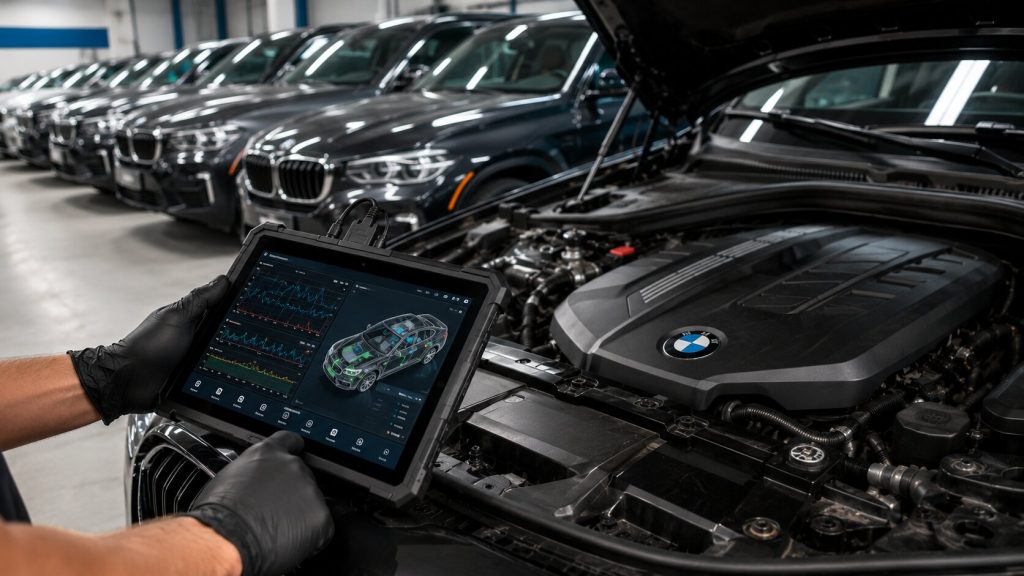
Factory-integrated BMW telematics systems predict maintenance needs and track fleet vehicle performance by transmitting real-time sensor data—such as electric water pump amperage and coolant thermal deltas—to a centralized cloud platform, allowing fleet managers to intercept mechanical failures before they cause operational downtime. When a business relies on a fleet of luxury or high-performance vehicles, waiting for a driver to report a dashboard warning light guarantees that internal engine damage has already occurred.
Industrial Corridor Stress on Fleet Vehicles
Operating a fleet near the Suncor refinery or navigating the heavy industrial cloverleaf at I-270 and Vasquez Boulevard subjects vehicles to severe load environments. At 5,280 feet, the ambient air is significantly less dense, drastically reducing the thermal efficiency of front-mounted radiators and transmission coolers.
This environmental reality is compounded by stationary heat soak during bottlenecks on US-85. While a fleet driver focused on their route might not notice a subtle drop in fuel efficiency or a minor performance lag, connected telematics systems identify these mechanical trends immediately. I routinely analyze cloud telemetry data capturing a water pump current deviation long before the vehicle enters limp mode, allowing for targeted intervention before a cylinder head suffers thermal warping.
Digital Twin Technology and Thermal Modeling
Modern BMW fleet monitoring utilizes virtual modeling to simulate vehicle performance under real-world conditions. This digital risk detection acts as a continuous health monitor, allowing technicians to identify a vacuum leak in a thermoplastic valve cover before an active emissions fault triggers.
- Altitude Adjusted Cooling The engine management system automatically accounts for Denver’s semi-arid climate, where the boiling point of engine coolant drops to 203 degrees Fahrenheit. Telemetry monitors the split-cooling valve positions to ensure the engine block and cylinder head are cooling independently under load.
- Electrical Load Tracking Continuous data transmission identifies if components like the electric water pump are pulling excessive electrical current. A milliamp-level fluctuation reliably signals that the internal circuit boards are running too hot and will soon fail.
- Airflow Balance Checks The vehicle continuously monitors the engine’s breathing to detect microscopic vacuum leaks or soot buildup on the intake valves caused by prolonged idling in Commerce City industrial zones.
Forensic Protocols for High Performance Fleets
I do not authorize fleet repairs based solely on a remote cloud alert. Accurate troubleshooting requires factory-grade forensic protocols to verify the digital signal and prevent unnecessary parts replacement.
When a fleet vehicle is pulled from the route based on a telemetry alert, we use ISTA/D software to manually trigger specific components. By activating the water pump and cooling fans via the computer, we monitor the live amperage fluctuations to confirm the internal circuit board heat stress indicated by the cloud data.
We then pressurize the cooling circuit to exactly 1.5 bar (21.8 psi). Documenting the pressure decay rate provides absolute proof that a system is mechanically airtight before a vehicle is dispatched on a long mountain haul.
Predictive Maintenance for Business Operations
Relying on reactive maintenance—waiting for parts to break on the road—results in repeated tows and interrupted deliveries. When a fleet manager utilizes predictive triggers based on engine hours and sensor health, they can schedule downtime on their own terms.
When telemetry indicates a cooling circuit is aging out, our operational standard involves targeted material upgrades rather than generic part swaps. We replace brittle plastic coolant flanges with 6061-T6 billet aluminum versions equipped with high-grade Viton seals. This material superiority permanently resolves known factory weak points, ensuring the fleet vehicle can handle extreme Front Range heat cycles without blowing a plastic connector on the highway.
Fleet Telemetry Evaluation Center
The digital twin thermal modeling, ISTA/D component triggering, and predictive maintenance protocols detailed in this guide dictate the fleet management standards at Salta Automotive. All telemetry data retrieval and billet material upgrades are executed at the European service bay located at 1001 E 75th Ave UNIT A, Denver, CO 80229. For specific inquiries regarding fleet vehicle health, the facility can be reached directly at (303) 974-2992.
Frequently Asked Questions
Can telematics predict a water pump failure before it happens?
Yes. By monitoring the electrical current draw of the pump, predictive systems can identify internal mechanical resistance or circuit board degradation weeks before a total shutdown occurs.
Does high altitude affect the accuracy of remote fleet data?
No. Modern engine management systems include internal barometric sensors that automatically calibrate the data for high elevations, ensuring that alerts for boost pressure or fuel trims remain mechanically accurate.
Will fleet monitoring software prevent every roadside emergency?
No. While software is highly effective at tracking electronic aging trends, a physical rupture in a brittle plastic cooling hose is an instantaneous structural event that telematics cannot forecast.
Are independent shops able to update my BMW digital service history?
Yes. Authorized independent specialists have the software clearance to update the central BMW database and the vehicle’s iDrive system, ensuring your fleet maintenance records are verifiable for compliance audits.
Is it safe to keep a fleet vehicle on the road if it drives fine after an alert?
No. Ignoring an early warning for a struggling cooling component or a fuel trim deviation can lead to immediate overheating and warped engine components during a heavy climb on I-70.