Advanced AI-driven software accelerates BMW engine repair by instantly analyzing live sensor data, thermal deltas, and bit-serial data bus errors to pinpoint failing water pumps and vacuum leaks before catastrophic thermal runaway occurs. Instead of manually guessing the source of an overheating event or idle hunt, technicians leverage predictive modeling to identify the exact failing component, drastically reducing diagnostic bay time and preventing major mechanical damage.
Thermodynamic Stress on Denver Commuters
If a vehicle commutes daily from the Reunion neighborhood into Denver, the engine undergoes a severe thermodynamic stress cycle. The transition from high-load highway speeds on I-76 to a dead stop at the I-25 interchange creates a massive heat soak event. Because the air at 5,280 feet is 17% less dense than at sea level, the cooling system struggles to shed that rapid temperature spike.
I frequently see vehicles towed into the shop with no dashboard warning lights illuminated, yet the engine management system has been silently compensating for weeks. Without software telemetry, these silent failures remain completely hidden from the driver until a critical thermoplastic component bursts.
Decoding Predictive Thermal Modeling
The engineering reality of modern BMW platforms is the deep integration of predictive failure software. This software evaluates emerging mechanical risks by tracking the thermal delta—the exact temperature difference between the cylinder head and the radiator outlet.
If the AI detects a microscopic increase in the electrical current draw of the electric water pump—even a deviation of a few milliamps—it flags the impending failure. Furthermore, the altitude compensation logic automatically adjusts the boiling point parameters for Denver’s elevation, utilizing split-cooling systems to manage the engine block and cylinder head independently. By reading this data, I can immediately distinguish between a vacuum leak in the plastic valve cover and a restricted heater management module based entirely on recorded thermal shifts.
Tracing Faults With Advanced Telemetry
Budget scan tools used by generic garages cannot access this level of predictive data. Accelerating a complex engine repair requires a documented telemetry protocol to provide absolute clarity on the mechanical fault.
Digital Motor Electronics Analysis
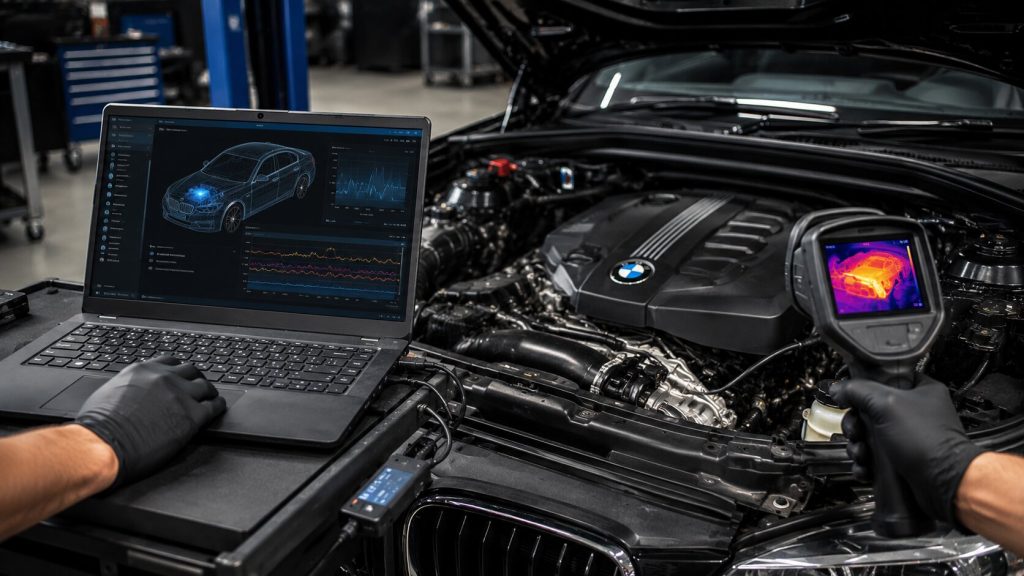
We utilize factory ISTA/D software to access the DME shadow memory. This allows us to map communication errors across the bit-serial data bus and identify digital jitter before it triggers a Check Engine Light.
Thermal Imaging Verifications
Software data is always paired with physical verification. By mapping the heat spread across the engine bay using a thermal imager, I can visually locate dangerous hot spots near the turbocharger coolant lines that correlate directly with the AI’s predictive thermal models.
Fuel Trim and Misfire Profiling
Using factory misfire counters, we detect early carbon buildup on the intake valves—a highly common issue for vehicles subjected to heavy school-zone idling. Catching this early prevents severe drivability issues and costly intake manifold damage.
Billet Material Upgrades Over Piecemeal Fixes
When the software indicates a cooling component is nearing its thermal limit, replacing a single burst hose is a mechanically flawed strategy. All thermoplastic cooling components in a BMW age at the exact same rate under Denver’s extreme heat cycles.
My operational standard involves a comprehensive system revamp. If the predictive data points to a failing primary coolant flange, I eliminate the factory plastic entirely, upgrading the circuit with a 6061-T6 billet aluminum replacement. This prevents the renewed system pressure from simply blowing out the next weakest plastic link during a mountain climb.
Defensive Maintenance Habits for High Altitudes
Vehicle health at altitude depends on proactive data collection. I recommend a full software telemetry audit every 30,000 miles to clear inactive history faults and verify the engine’s thermal safety margins.
Additionally, adhering to the factory 10,000-mile oil change algorithm in Colorado’s dry climate allows synthetic oil to become highly acidic, deteriorating internal rubber gaskets. Shortening this interval to 5,000 miles is the most effective defense. Finally, a weekly sustained high-speed drive on E-470 allows the engine management system to update fuel maps and effectively burn off stubborn carbon deposits.
Technical Testing Location
The thermal delta monitoring, ISTA/D software evaluations, and predictive data bus verifications detailed in this technical bulletin dictate the repair protocols at Salta Automotive. All software telemetry scans and billet material upgrades are executed at the European service bay located at 1001 E 75th Ave UNIT A, Denver, CO 80229. For specific telemetry inquiries, the facility can be reached directly at (303) 974-2992.
Frequently Asked Questions
Does high altitude make a BMW engine more likely to fail?
Yes. Thinner air reduces the cooling system’s ability to dissipate heat by up to 17 percent, leaving a significantly smaller margin for error if a mechanical part begins to degrade.
Can a dashboard light be off while the engine has a problem?
Yes. Many BMW engine issues begin as shadow codes or inactive faults in the computer’s memory that only specialized factory software can extract.
Is it safe to ignore a sweet smell under the hood?
No. That odor is vaporized glycol from a coolant leak. Ignoring it leads to immediate air introduction into the cooling system, causing localized boiling and warped cylinder heads.
Will a standard code scanner find all hidden engine faults?
No. Standard scanners only read generic emissions data and cannot access the deeper shadow memory or bit-serial data bus error logs required for accurate performance forensics.
Does a dry environment cause plastic engine parts to break faster?
Yes. The extreme morning-to-afternoon temperature swings in Colorado rapidly accelerate the crystallization and physical cracking of polyamide cooling flanges and vacuum lines.