
If your daily commute consists of short, 1.5-mile cold hops up Highway 2 or quick surface errands along 72nd Avenue, you are inadvertently starving your BMW of the heat it needs to survive. In neighborhoods like Derby, frequent short-trip driving prevents European engines from reaching their self-cleaning thermal thresholds, creating stubborn carbon blockages that inevitably trigger the Check Engine light.
The Physics of the Derby “Cold Hop”
Modern BMW engines are marvels of tight thermal management, but they need at least 20 minutes of at-temperature driving to sweat out normal combustion byproducts. When you routinely shut the car off right as the engine oil hits 160°F—well below the 212°F needed to boil off trapped condensation and raw fuel vapors—the Positive Crankcase Ventilation (PCV) system can’t do its job. The oily blow-by gets trapped in the cold intake tract and bakes into a dense, airflow-restricting crust.
When I pull the live data off commuter BMWs coming in from the Commerce City corridors, the story is always the same: the DME (engine computer) is fighting to keep the car from stumbling at a stoplight, and the driver’s fuel economy has tanked because the system is trying to shove fuel down a choked throat.
Direct Injection vs. The “Fuel Additive” Myth
The most common conversation I have at our front desk involves fuel additives. A driver comes in with a rough-idling N55 or B48, sets a bottle of over-the-counter injector cleaner on the counter, and asks why their Check Engine light is still on.
I have to pull up the diagram and break the news: your BMW is Gasoline Direct Injection (GDI). The fuel injectors sit inside the cylinder, firing gasoline directly at the spark plug under thousands of pounds of pressure. Because the fuel completely bypasses the intake ports, pouring chemical cleaners into your gas tank will never touch coked intake valves.
When repeated short trips allow that PCV sludge to bake on, the engine gets hit from two sides:
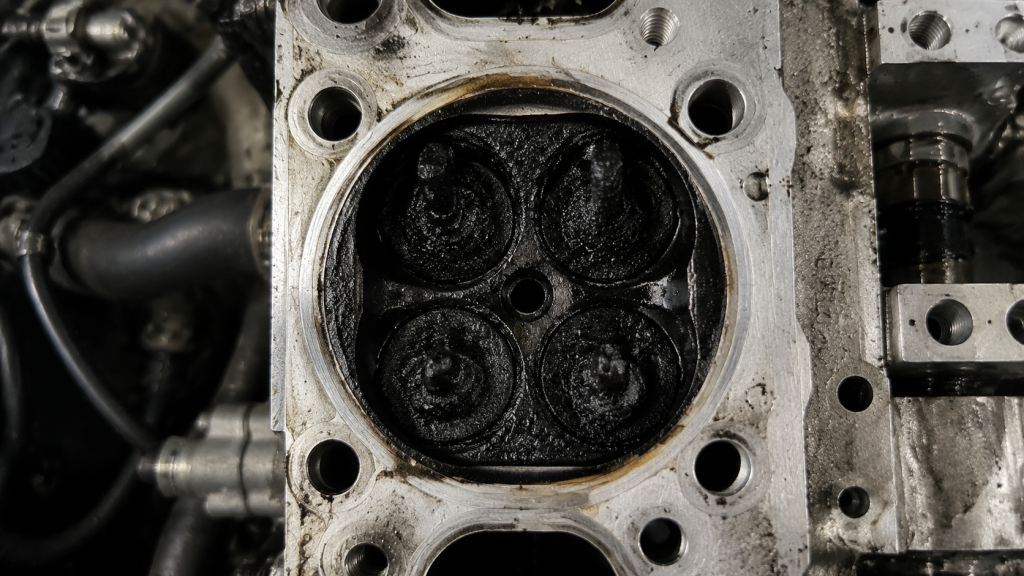
- Choked Intake Valves: Thick, glass-hard carbon bakes onto the dry valve stems, physically choking off the air entering the cylinder and ruining the smooth tumble of the intake charge.
- Deformed Injector Tips: Inside the cylinder, wet soot bakes over the microscopic holes of the high-pressure injectors, turning a surgical fuel mist into an uneven, sloppy stream.
Teardown Reality on the Shop Lift
To give you an idea of what we actually look at when we pull these intake manifolds apart on the bench, here is the standard progression of short-trip damage:
| Component | Short-Trip Impact & Symptoms | Required Shop Action |
| Intake Valves | Oily PCV sludge bakes into hard carbon; causes rough idling and cold-start misfires. | Pressurized walnut shell blasting down to bare metal. |
| Direct Injectors | Soot accumulation fouls multi-hole tips; triggers Check Engine light and rich fuel trims. | High-pressure, professional chemical rail flush. |
| Engine Oil | Unburned fuel and condensation dilute lubrication; accelerates timing chain wear. | Shortened 5,000-mile synthetic oil service intervals. |
The Forensic Baseline — Fixing the Actual Airflow
This is why reading generic OBD-II codes at an auto parts store gets expensive fast.
During a recent diagnostic baseline on a short-tripped X3, a basic handheld code reader just spat out random cylinder misfires. The owner was convinced his high-pressure fuel pump was failing. But when I hooked up our Autel MaxiSYS Ultra and looked at the live telemetry, the smoking gun was sitting right there in the fuel trims: a massive positive deviation. The computer was holding the injectors open way too long just to force enough fuel past the sludge.
Instead of selling him a $1,800 fuel pump he didn’t need, we pulled the intake and executed a professional walnut shell blasting service. Using pressurized crushed walnut shells, we blasted the baked-on carbon off the aluminum valves. The moment the factory port volume was restored, the engine could breathe, the fuel trims snapped back to zero, and the misfire codes vanished.
Preventative Logic for Denver Commuters
You don’t have to stop taking quick 2-mile trips around Derby, but you do have to offset the tax it takes on the motor:
- The “Clearance Run”: Once a week, skip the surface streets and take the car for a 25-minute continuous run down I-270 or I-25. Getting the oil sustained past 212°F allows the crankcase to fully breathe out the trapped moisture.
- Halve the Oil Intervals: If your car lives on local streets, the factory 10,000-mile oil interval will cause sludge to kill your turbocharger bearings. Drop your interval to 5,000 miles.
- Maintain the Voltage: Short hops don’t give the alternator enough time to top off the battery. Because low voltage causes BMW sensors to drift and throw ghost codes, putting the car on an AGM smart maintainer on cold Denver nights is a massive safeguard.
Restore Your BMW’s Factory Breath
Ignoring a hunting idle or a Check Engine light inevitably leads to burned-out ignition coils, ruined injectors, and plugged catalytic converters. If your daily driving routine is choking your BMW, let our technicians get to the actual root of the restriction.
Schedule a live fuel trim audit and factory-grade walnut shell blasting service with the European specialists at Salta Automotive. Pull into our facility at 1001 E 75th Ave UNIT A, Denver, CO 80229.
Frequently Asked Questions
Why does my BMW Check Engine light come on after driving short distances around Derby?
Short trips prevent your engine from reaching its critical self-cleaning thermal threshold. This leaves unburned fuel and moisture in the crankcase, which bakes into hard carbon deposits on your intake valves and direct injectors, throwing off the precise air-fuel ratio.
Will premium gas or over-the-counter fuel additives cure my rough idle?
No. Because modern BMWs use Gasoline Direct Injection (GDI), the fuel is sprayed directly into the cylinder and completely bypasses the intake valves. Pouring additives into the gas tank cannot physically reach or clean the carbon baked onto the valve stems.
What exactly is walnut shell blasting?
Walnut shell blasting is a factory-approved maintenance procedure where technicians use specialized blasting wands and pressurized, crushed walnut shells to blast hardened carbon off the intake valves. The shells are aggressive enough to chip away the glass-hard carbon sludge, but soft enough to leave the bare aluminum cylinder head completely undamaged.
How do I know if my fuel injectors are clogged or if my intake valves are coked?
Both issues share symptoms like poor fuel economy, hesitation off the line, and a Check Engine light. However, cold-start misfires that smooth out as the engine warms up usually point to coked intake valves, while constant black soot on the exhaust tips and permanent hesitation indicate fouled direct injectors.