
Commuting to Denver from Reunion means your BMW faces brutal traffic every morning. Repeated stops in this traffic generate significant heat, which gradually weakens your rotors and wears down your brake pads. In this article, we’ll explain why commuter driving shortens brake life, highlight warning signs to watch for, and offer tips on how timely brake inspections can catch wear early, saving you from more costly repairs later on.
Why Does the Reunion-to-Denver Commute Wear BMW Brakes Faster
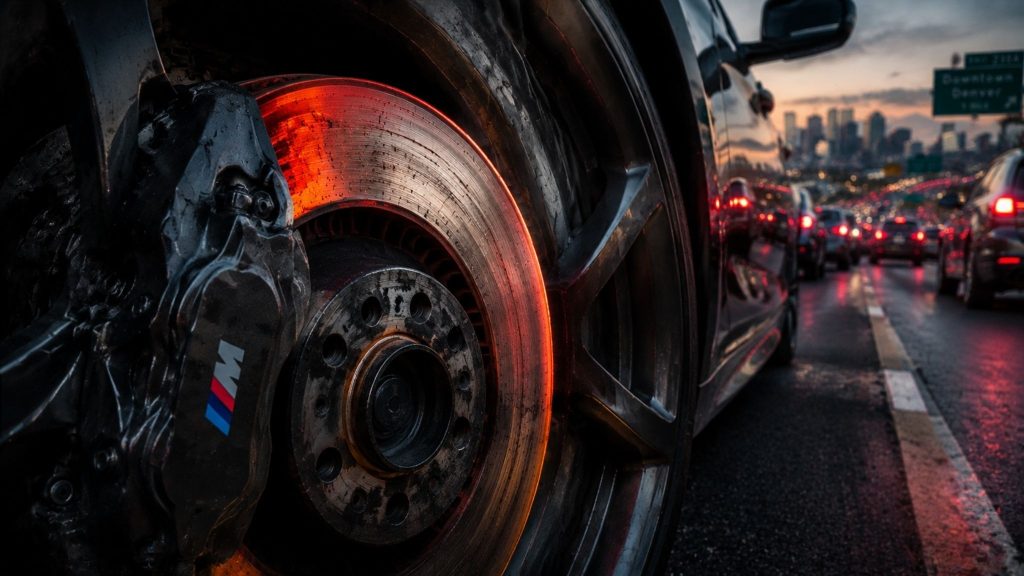
BMW brake wear depends less on total mileage and more on how and where the vehicle is driven. While steady highway cruising is easy on your vehicle, the daily stop-and-go commute from Reunion into Denver subjects your braking system to relentless punishment.
This specific travel pattern forces your brakes to handle:
- Constant Speed Drops and Sudden Slowdowns: Merging and navigating unpredictable traffic crawls require rapid, repeated brake applications.
- Severe Thermal Buildup: Because stops occur in rapid succession, your brakes never have time to cool down. This trapped heat accelerates parts degradation.
- Heavy Forward Weight Transfer: Every time you slow down, the momentum of your BMW shifts its weight heavily toward the front nose. This forces the front brake components to absorb the brunt of the kinetic energy, accelerating wear.
Even the most gentle drivers cannot avoid the physics of the Denver commute. The resulting friction and intense heat will eventually break down your braking components, making routine professional inspections vital to your vehicle’s safety. Coupled with Colorado’s harsh weather and thin air the daily drive acts as an accelerated wear test for your entire brake system.
Why Does This Matter More Than Most Drivers Realize
Brake maintenance isn’t just about waiting for a dashboard light; it’s about protecting your vehicle’s entire stopping system. Colorado’s heavy traffic and mountain descents put immense thermal stress on your brakes. When early warning signs are ignored, excessive heat can warp or damage secondary components, leading to compromised safety and steep repair bills.
A Denver-driven BMW regularly subjected to heavy traffic loads may develop:
- Uneven Wear: Caused by heat-stressed calipers failing to distribute pressure evenly.
- Rotor Hot Spots: Extreme heat buildup that leads to permanent material degradation.
- Pulsation or Vibration: Annoying feedback felt through the steering wheel or pedal.
- Complete System Degradation: Where ignored wear cascades into damaged calipers and ruined rotors, requiring major mechanical repair.
For your safety alone, it is vital to pay attention to small changes in pedal feel before they turn into a major hazard.
How Does the BMW Brake System Handle Daily Commuting
BMW braking systems are built to provide strong, confident stopping with good pedal feel and predictable control. But that performance comes from a system that is relatively sensitive to wear, temperature, and component condition. In simple terms, the system works like this:
- Pressing the brake pedal creates hydraulic pressure.
- That pressure moves the brake calipers.
- The calipers press the brake pads against the rotors.
- Friction slows the wheels and stops the vehicle.
- Heat is generated every time this happens.
For BMWs, which often use softer, high-performance brake compounds for a better stopping feel, this can lead to faster pad wear and increased rotor stress compared to non-performance vehicles.
Common Problems in BMW Brake Systems for Commuters
Not every brake repair starts with a major failure. Most begin with normal wear that goes unchecked a little too long.Common issues for commuters include:
- Brake pad wear: Most common issue for daily commuters who use brakes more often. BMW pads wear quickly depending on conditions.
- Rotor heat stress: Repeated or continual braking causes heat cycles, potentially leading to vibration, noise, or uneven braking.
- Caliper or hardware sticking: Brake hardware not moving freely can cause uneven or faster wear on one side, or slight dragging.
- Brake fluid condition: Fluid absorbs moisture; neglected fluid in commuter vehicles with daily heat cycles affects pedal feel, braking performance, and consistency.
- Sensor-triggered brake warnings: BMW alerts indicate service is due, but a proper inspection is still needed to assess wear progress and other effects.
What Symptoms Should Reunion Commuters Watch For
Brake problems can range from the obvious to the subtle. Being aware of the early warning signs is essential for timely maintenance. Here are some common symptoms you
should watch for:
| Symptom Category | Specific Warning Signs |
| Noise | Squealing or scraping soundsReduced smoothness during low-speed stops |
| Feel/Vibration | A pulsing brake pedalVibration in the steering wheel while brakingA soft or spongy pedal |
| Performance/Warning | A brake service warningPulling to one side under brakingLonger stopping distance |
| Smell | A burnt smell after repeated traffic brakingIt is easier to smell another car’s brakes ahead of you than your own, unless your car is stopped. |
Remember that these symptoms are just the warning signs, not necessarily the root cause. For instance, a vibration may indicate pad transfer or heat imbalance rather than simply “warped rotors.” Always prioritize professional inspection over assumption for accurate diagnosis.
What Can Drivers Do to Reduce Brake Wear
Brake wear is inevitable, but you can slow unnecessary wear and catch problems
Early. Smart commuter habits:
- Increase following distance to avoid hard braking.
- Coast early when slowing.
- Don’t ignore minor brake noise.
- Promptly inspect brake warnings.
- Maintain brake fluid service.
- Request a full brake inspection, not just a pad check.
Waiting until brakes grind is unsafe and can result in a larger repair. Another misconception is that recently replaced pads mean the whole system is fine. Rotor, caliper, sensor, and fluid health all matter.
Why a Specialized BMW Brake Inspection is Essential
If your BMW is a daily commuter, a standard “visual check” isn’t enough. At Salta Automotive, we approach brake concerns by looking at the whole picture—rotor thickness, hardware movement, and fluid contamination.
For Reunion drivers, catching a wear pattern early is often the difference between a routine maintenance visit and an emergency repair.
Don’t let Colorado traffic compromise your safety. If your brakes are sounding loud or feeling soft, get a precision inspection from the team that understands the demands of the Denver commute. Schedule Your Precision BMW Brake Inspection today!
Visit us at 1001 E 75th Ave UNIT A, Denver, CO 80229.
Brake Questions Reunion BMW Drivers Commonly Ask
Do BMW brakes wear faster than other vehicles?
Often, yes. BMW brake systems are designed for responsive stopping and performance feel, which can lead to faster pad wear under commuter conditions.
Is highway commuting easier on brakes?
Usually, yes — but only if traffic stays open. Heavy stop-and-go commuting is much harder on brakes than steady cruising.
Why do my brakes feel fine but still need service?
Brake wear does not always feel dramatic right away. Pads and rotors can be worn beyond ideal limits without developing any issues. This just means you used them well and got the best life out of them!
Can I wait until the brakes start making noise?
That is not the best strategy. BMW’s and most other modern cars have designed noise making as a sign of wear out of the braking systems. Waiting for the brakes to make noise in order to service them could result in an unsafe amount of wear.
Do rotors always need to be replaced with brake pads?
Almost always. BMW brakes are performance oriented and the rotors are made thin to reduce weight in the braking and suspension system. As a result the discs are usually not thick enough to last more than one set of pads.
How often should commuter BMW brakes be checked?
For daily commuters, regular brake inspections are smart even before obvious symptoms appear, especially if the car is driven heavily in traffic.