
If you live in the residential subdivisions surrounding Buffalo Run Golf Course, your daily commute subjects your BMW to a unique type of structural fatigue. While European suspensions are engineered for high-speed autobahn stability, the constant lateral loading from neighborhood roundabouts, concrete drainage dips, and surface transitions off 112th Avenue can accelerate suspension wear by up to 25%.
Here is a clinical breakdown of why local surface driving degrades modern BMW handling, and how to spot early-stage mechanical separation before it ruins your tires.
The Physics of Stop-and-Go Neighborhood Weight Transfer
The incredible handling responsiveness of a modern BMW (whether a 3 Series or a heavy X5) relies on a complex multi-link front suspension. To balance road isolation with surgical steering feel, BMW utilizes hydraulic tension strut bushings (often called thrust arms). Unlike solid rubber domestic bushings, these feature fluid-filled pockets that dampen NVH (Noise, Vibration, and Harshness).
When you routinely brake hard at local four-way stops or hit the aggressive residential speed humps around Commerce City, the massive kinetic energy of the vehicle shifts entirely onto these fluid-filled rubber pockets. Over time, the hydraulic fluid literally hammers its way out of the rubber core.
When I pull commuter vehicles from the Buffalo Run area onto our diagnostic lifts at Salta Automotive, the story is incredibly consistent: a customer comes in frustrated because their front tires are scrubbed down to the secondary rubber after just 12,000 miles. They think they bought a bad set of tires, but the smoking gun is sitting right there in the front suspension geometry.
The Three Primary Points of Structural Compromise
Rather than guessing at generic clunks, look at the exact mechanical failure points we document during our routine undercarriage inspections:
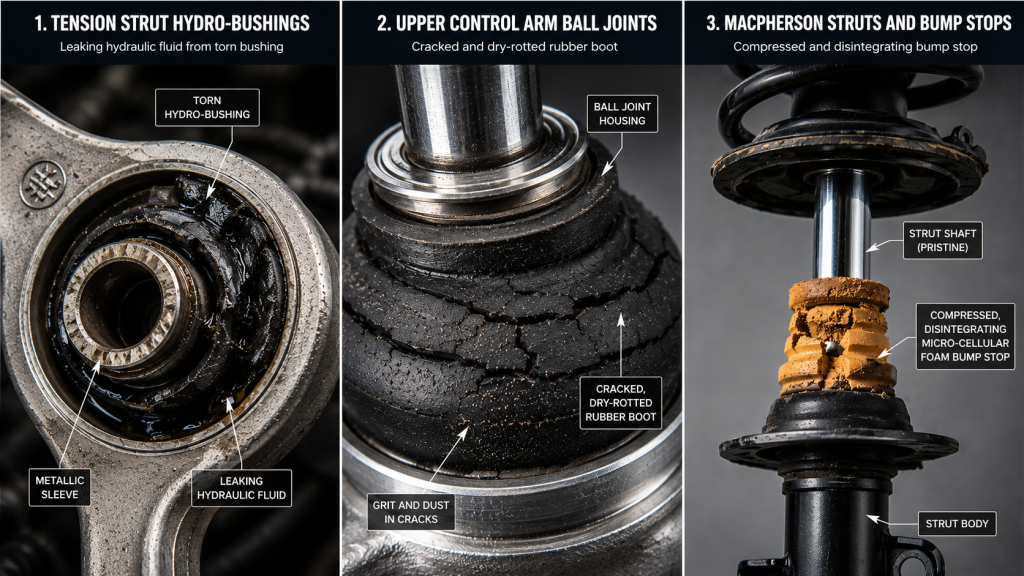
1. Tension Strut Hydro-Bushings (Thrust Arms)
This is the most common mechanical casualty of local surface driving. When the internal fluid leaks out, the front wheel gains excessive back-and-forth play inside the wheel well. You will feel this as a subtle, unsettling “shimmy” or steering wheel wobble specifically when you tap the brakes at highway speeds coming down I-76.
2. Upper Control Arm Ball Joints
Navigating the tight, continuous turning radiuses of neighborhood cul-de-sacs places heavy shearing stress on the sealed ball joints. When the protective rubber boots crack from dry Colorado air, grit enters the polished metal housing, scouring the joint and causing a distinct, high-pitched squeak when turning the wheel at low speeds.
3. MacPherson Struts and Bump Stops
Repeatedly bottoming out over local subdivision drainage gutters crushes the micro-cellular foam bump stops riding on the strut shafts. Once these disintegrate, the raw impacts transfer directly into the upper strut mounts and suspension linkages, mushrooming the structural aluminum towers and causing a heavy, hollow structural “clunk” over minor road imperfections.
Diagnostic Lift Reality and the BMW X5 Weight Factor
The structural toll of local driving scales dramatically with curb weight. Late-model BMW X5 and X7 platforms easily exceed 5,000 pounds.
When pinpointing complex undercarriage faults on these heavy SAVs from the Buffalo Run neighborhoods, visual inspections with the vehicle sitting on the ground are completely useless. The weight of the engine traps the worn rubber, making a blown bushing look pristine to the naked eye. To find the actual deviation, we have to lift the vehicle off its wheels and apply specialized leverage bars to the lower control arms. We frequently watch the central aluminum sleeve pull completely free from its outer rubber casing—a massive safety hazard that forces the vehicle’s Dynamic Stability Control (DSC) to constantly micro-correct your steering.
Early Failure Identification Matrix
| Observable Symptom | Mechanical Component at Fault | Required Diagnostic Action |
| Steering Shimmy Under Braking | Ruptured Tension Strut Hydro-Bushing | Inspect for leaked black hydraulic fluid; replace arms in pairs. |
| Hollow Clunk Over Speed Humps | Degraded Strut Mounts / Bottomed Shocks | Check strut shaft rebound damping and foam bump stop integrity. |
| Severe Inner Shoulder Tire Wear | Control Arm Geometry Collapse | Perform a loaded 4-wheel alignment audit and inspect lower wishbones. |
Proactive Preservation for Commerce City Drivers
You don’t have to change your daily route to protect your vehicle’s handling precision. You simply need to adopt a few mechanical safeguards:
- Creep Through Drainage Dips: Never hit concrete neighborhood surface transitions while actively standing on the brake pedal. Braking locks the front suspension travel; release the brakes a split second before impact so the struts can freely articulate.
- Enforce Annual Leverage Audits: Do not rely on quick lube visual checks. Ensure your European technician puts a physical pry bar on the multi-link geometry during your routine 5,000-mile oil changes and preventive maintenance.
- Maintain Cold Inflation Pressures: Wide, low-profile BMW tires act as the first line of suspension defense. Dropping just 4 PSI during cold Denver mornings forces the underlying aluminum control arms to absorb the sharp square-edge impacts of local road seams.
Restore Factory BMW Steering Dynamics
Continuing to drive on compromised control arm bushings will permanently cup your expensive tires and eventually bend your underlying steering rack. If your BMW feels wandering, vague, or noisy over the roads of Commerce City, stop relying on alignment patches that don’t fix the underlying mechanical play.
Bring your vehicle to the European specialists at Salta Automotive for a precision four-wheel alignment and loaded suspension geometry audit. Visit our facility at 1001 E 75th Ave UNIT A, Denver, CO 80229 to restore the tight, surgical handling your BMW was built for.
Frequently Asked Questions
Why does neighborhood driving around Buffalo Run wear out my suspension faster than highway driving?
Highway driving involves minimal steering input and smooth, continuous rolling loads. Local subdivision driving involves heavy weight transfer from constant stop-and-go braking, tight turning radiuses, and sharp vertical impacts from concrete gutter dips, which rapidly degrades fluid-filled rubber bushings.
Can a bad alignment cause my control arm bushings to fail?
Yes. It is almost always the exact opposite: failing control arm bushings cause your alignment to fall out of specification. As the rubber core tears, the wheel shifts dynamically under acceleration and braking, making a permanent wheel alignment completely impossible until the physical arms are replaced.
Why does my BMW squeak over bumps only when it’s cold outside?
Rubber control arm bushings and sway bar insulators contract and harden in freezing Denver temperatures. If the rubber is old and dry-rotted, it shrinks away from its steel mounting brackets, causing metal-to-rubber friction and loud squeaking until the ambient friction warms the components back up.
Should I replace my BMW struts and control arms individually or in pairs?
Yes, always replace suspension components across the same axle in pairs (both front left and front right). Because both sides experience the exact same mile count and road conditions, replacing just one side leaves an imbalanced spring rate and damping curve, which will immediately ruin the handling feel and rapidly destroy the fresh component.