
Replacing a set of cupped or unevenly worn BMW tires without first diagnosing the hydraulic thrust arm bushings guarantees the new rubber will suffer the exact same rapid degradation. Worn suspension components allow the wheel assembly to shift dynamically under braking and cornering load, meaning the vehicle’s alignment constantly changes while in motion. Identifying and replacing the failed control arms stops this destructive tire scrubbing and restores factory handling precision.
The Mechanics of Dynamic Alignment Shifts
Drivers frequently try to solve a steering vibration or pulling issue by purchasing a premium set of tires and paying for a standard wheel alignment. Mechanically, this is a dangerous gamble if the suspension has not been load-tested.
An alignment machine only measures the geometry of the wheels while the vehicle is parked statically on a laser rack. If the vehicle has a torn control arm bushing, the wheel hub is free to shift backward and laterally the moment the car encounters physical torque. This phenomenon is known as a dynamic alignment shift. You can mount a brand-new set of tires and perform a perfect static alignment, but the moment you hit the brakes on I-25, the damaged suspension allows the wheels to toe outward, instantly scrubbing the fresh tread blocks against the pavement.
Dissecting the Hydraulic Thrust Arm Bushing
BMW engineers achieve their signature balance of tight steering and smooth ride quality by utilizing hydraulic thrust arm bushings. Unlike solid rubber mounts found on economy cars, these advanced bushings encapsulate a damping fluid inside a rubber housing to isolate high-frequency road vibrations.
However, the severe road conditions across the Front Range—including the industrial ruts near Commerce City and pothole-ridden stretches of Santa Fe Drive—place immense stress on these fluid-filled chambers. The failure sequence is mechanical and inevitable. The outer rubber housing cracks from ozone exposure and violent road impacts, allowing the internal damping fluid to escape. Once dry, the bushing completely loses its hydraulic resistance, leaving the control arm free to oscillate violently under load.
Front Range Road Stress and Tramlining Symptoms
When these hydraulic components fail, the symptoms extend far beyond tire wear. The vehicle will begin to exhibit a handling defect known as tramlining. Because the suspension can no longer hold the wheels strictly parallel, the tires will aggressively follow the natural grooves, ruts, and imperfections in the road surface.
The steering wheel will feel incredibly loose, requiring constant micro-corrections to keep the car centered in the lane. Furthermore, drivers will often experience a severe steering wheel shake at highway speeds or a heavy clunking sound during sudden deceleration. Many drivers misdiagnose this as a warped brake rotor, but it is actually the entire wheel assembly violently shifting backward inside the wheel well.
Service Bay Evaluation Protocols
I refuse to throw replacement parts at a chassis based on a visual guess. Finding the exact point of suspension failure requires physical load testing in the service bay.
The Brake-Load Test
While driving the vehicle at low speeds, applying sharp, sudden brake pressure forces the vehicle’s weight to transfer to the front axle. If a thrust arm bushing is fully ruptured, this load transfer will cause the wheel to visibly jerk backward with an audible clunk.
The Pry Bar Stress Test
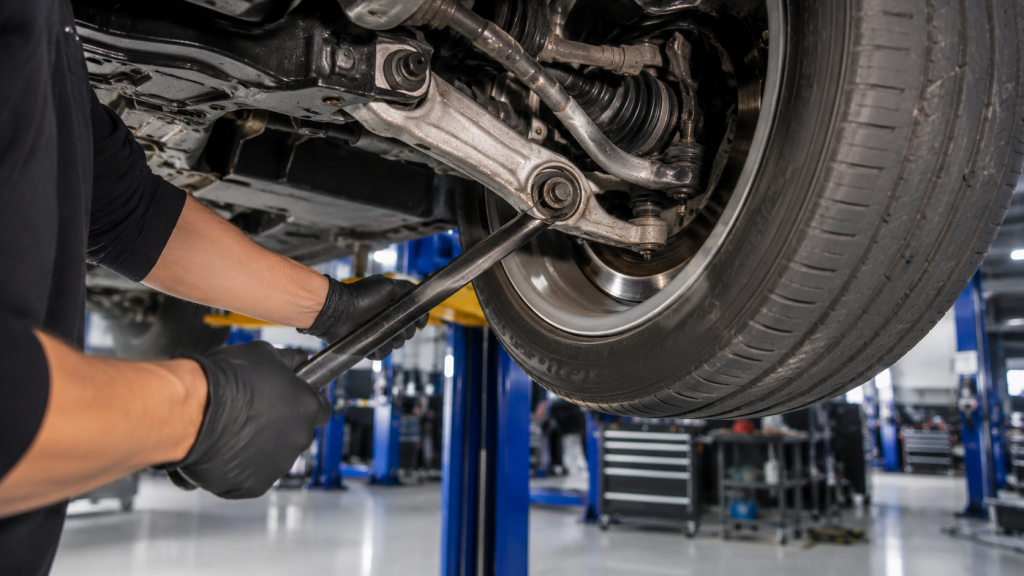
Once the vehicle is secured on a lift, a visual inspection is never enough. I use a heavy pry bar to apply manual leverage against every ball joint and control arm mount. We are feeling for mechanical play that should not exist and looking for the distinct black residue of leaked hydraulic fluid staining the aluminum suspension arms.
Tactile Tread Mapping
The tires themselves act as a forensic map. By running a hand flat against the direction of the tread, I can feel “feathering”—sharp, raised edges on the tread blocks. Feathering confirms that the tire is being dragged sideways down the road due to failing suspension geometry.
Why Complete Assembly Replacement is Required
When a thrust arm bushing fails, simply pressing a new rubber bushing into the old aluminum arm is rarely the optimal repair. BMW suspension components act as a unified system. If the rear hydraulic bushing has absorbed 70,000 miles of Denver road impacts, the front ball joint on that exact same arm has absorbed the exact same stress.
My operational standard is to replace the entire thrust arm assembly as a complete, original-equipment unit. This ensures the new ball joint and the new hydraulic bushing are perfectly matched, guaranteeing long-term durability and completely resetting the front-end geometry.
Diagnostic Facility Specifications
The suspension load-testing procedures, dynamic alignment principles, and hydraulic bushing evaluations outlined in this technical guide dictate the chassis repair standards at Salta Automotive. All physical evaluations and component replacements are conducted at the European service bay located at 1001 E 75th Ave UNIT A, Denver, CO 80229. For specific handling evaluations, the facility can be reached at (303) 974-2992.
Frequently Asked Questions
Can a bad suspension ruin new BMW tires quickly?
Yes. A torn bushing allows the wheel assembly to shift laterally while driving, continuously dragging the new tire tread sideways against the pavement and causing rapid, uneven wear.
Is a steering wheel vibration always caused by warped brakes?
No. A ruptured hydraulic thrust arm bushing will allow the wheel to oscillate violently under braking pressure, creating a severe steering wheel shake that mimics a warped brake rotor perfectly.
Do BMW suspension bushings actually contain fluid?
Yes. Many modern BMW thrust arm bushings are hydraulically filled. They use a sealed fluid chamber inside a heavy-duty rubber housing to absorb high-frequency road vibrations before they reach the steering column.
Should BMW suspension control arms be replaced in pairs?
Yes. Left and right suspension components experience the exact same road impacts, mileage, and thermal fatigue. Replacing related components together is the only effective way to maintain balanced steering geometry.
Can a wheel alignment fix BMW wandering steering?
No. An alignment machine only measures the wheels statically while the vehicle is parked. If a torn bushing allows the wheel to move dynamically while driving, an alignment cannot prevent the vehicle from wandering or tramlining on the highway.