
A BMW check engine light means the vehicle has detected a condition that requires attention, but the warning does not identify the exact part that needs replacement. Fault codes provide a starting point. Accurate diagnosis requires technicians to interpret the available information, inspect the relevant system, and perform appropriate testing before recommending repairs.
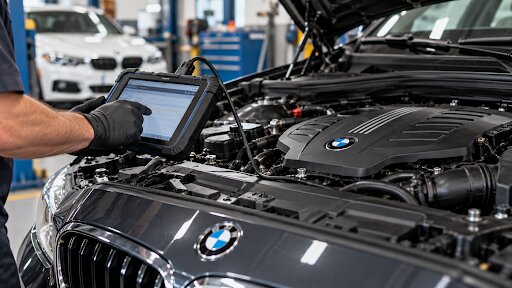
BMW Check Engine Light Diagnosis
- Codes Indicate Conditions, Not Parts: A BMW fault code flags a system condition or reading outside normal parameters, however it does not pinpoint the failing component.
- Multiple Causes per Fault: Complex BMW sensor networks mean a single code (like a misfire or underboost warning) can stem from several distinct electrical, mechanical, airflow or other issues.
- Testing Prevents Unnecessary Repairs: Proper physical inspections, system data analysis, and targeted testing are required to isolate the root cause before replacing parts.
A Fault Code Is the Beginning of the Investigation
When the check engine light appears, retrieving stored diagnostic trouble codes is an important first step. A code identifies the system or operating condition in which the vehicle detected something outside its expected range, but it does not identify the component responsible.
A fault code is somewhat like a ZIP code. It narrows the search to a particular area, but additional information is needed to locate the exact address. Some BMW codes are more specific than others, yet even a detailed code must be considered alongside the vehicle’s symptoms, operating data, service history, and physical condition.
This is why Salta Automotive approaches a BMW warning light as a problem to understand rather than a direction to replace the first component named in a code description.
What a BMW Check Engine Light Means
Modern BMWs monitor many aspects of engine and emissions operation. Depending on the model and powertrain, the engine control system may evaluate fuel mixture, ignition, airflow, boost pressure, operating temperatures, emissions performance, and communication with related control modules. When monitored information falls outside an expected range, the system may store a fault code and illuminate the malfunction indicator light.
The code records what the vehicle detected but not why it happened. For example, an underboost code means the engine control system detected less boost pressure than expected under certain operating conditions. The turbocharger is part of that system, but the code alone does not prove that the turbocharger has failed. The condition could also involve the charge-air path, boost control, a sensor input, wiring, or another system issue.
Why One BMW Fault Code Can Have Several Causes
BMW systems depend on information shared by sensors, actuators, mechanical components, wiring, and control modules. A problem in one area can affect how another part of the vehicle operates, which is why one code may have several possible causes. A mixture fault, for example, could be associated with unmetered air, fuel delivery, incorrect sensor information, or another condition affecting combustion.
A cylinder-specific misfire code identifies where the misfire was detected, but the cause might involve ignition, fuel delivery, airflow, wiring, or a mechanical condition. An oxygen-sensor fault also does not automatically establish that the sensor itself needs replacement. Depending on the exact code, the fault may concern the sensor circuit, heater operation, response, or a reading caused by another condition in the engine or exhaust system.
Replacing a part solely because its name appears in a code description can lead to an incorrect repair. Testing helps determine whether that component has failed or is reporting the effects of a different problem.
BMW Experience Helps Direct the Testing
Experience with BMW vehicles can make diagnosis more efficient. Technicians who regularly work with BMW systems become familiar with model-specific patterns, system relationships, and the information that deserves attention first. That familiarity is useful, but a familiar pattern is not proof.
Two BMWs can store similar codes for different reasons, even when they share the same model or engine family. At Salta Automotive, experience helps guide the evaluation without replacing it. The recommendation should follow the available evidence for the vehicle being inspected rather than an assumption based only on what commonly fails.
Why BMW-Specific Information Matters
A basic OBD-II code reader can retrieve certain emissions-related codes, but a BMW contains information that a generic reader may not display. Manufacturer-specific fault information and data from individual vehicle systems can provide additional context about when and how a condition occurred. Access to more information does not mean the equipment diagnoses the vehicle by itself.
A scan tool reports codes, system data, and other recorded information. Technicians must decide what is relevant, compare that information with the symptoms, and determine which inspections or tests are appropriate. Salta Automotive’s BMW repair services in Denver focus on understanding how these systems work together. That vehicle-specific knowledge helps the team interpret available information without treating a fault code as an automatic parts recommendation.
What Diagnosis May Involve
No single procedure applies to every BMW check engine light. The appropriate evaluation depends on the fault, the vehicle’s behavior, its maintenance and repair history, and what technicians observe during the initial inspection. Depending on the symptoms and system involved, diagnosis may require reviewing fault information, examining relevant operating data, inspecting accessible components, checking electrical circuits, or performing an appropriate mechanical or system test.
These are examples of procedures that may be used generally; the necessary tests are selected according to the condition presented by the vehicle. Salta Automotive’s diagnostic services include physical inspection and digital reporting. When visible conditions are documented, customers can receive photos and technician notes that help explain what was found and what may require further attention.
The objective is to gather enough evidence to recommend an appropriate next step. In some cases, the cause may become clear quickly. More complex or intermittent problems may require additional testing before a conclusion can be reached.
Why Clearing the Code Is Not a Repair
A check engine light may turn off after several drive cycles if the vehicle does not detect the condition again. Someone can also clear stored faults with a scan tool. Neither situation confirms that the underlying problem has been repaired. Some faults occur only under particular temperatures, loads, speeds, or driving conditions.
An intermittent problem may therefore disappear temporarily and return when those conditions occur again. Clearing faults before the vehicle is evaluated may also erase stored information that could help technicians understand the circumstances surrounding the event. It can reset emissions-monitor readiness as well, which may affect an emissions inspection until the required monitors run again.
If the check engine light repeatedly returns, the more useful next step is to have the condition evaluated instead of continuing to clear it.
Steady and Flashing Check Engine Lights Are Different
A steady check engine light means the vehicle has detected a fault, but the urgency depends on how the BMW is operating and whether other warnings or symptoms are present. If the vehicle runs normally, contact a repair facility for guidance and arrange an appointment for diagnostic.
A flashing check engine light commonly indicates an active misfire severe enough to risk damaging the catalytic converter. In this case it is best to pull over as promptly as possible to a safe spot and shut off the engine and follow the instructions in the owner’s manual which in this case will typically advise towing the car to a service location. If the BMW is shaking, running very poorly, losing substantial power, or displaying additional warnings, stop in a safe location and arrange assistance.
Overheating and low oil pressure may be communicated through separate BMW warnings rather than the check engine light itself. Those warnings require prompt attention. Do not continue driving solely because the check engine light is steady when another serious warning or symptom is present.
Clear Findings Lead to Better Repair Decisions
A fault code is valuable because it gives technicians a direction in which to begin. BMW-specific information and vehicle experience help narrow the possibilities, while appropriate inspection and testing help determine which condition is actually present. This process supports a repair recommendation based on the vehicle’s needs rather than the name of a component in a code description. It can also help customers understand why a particular repair is being recommended before deciding how to proceed.
If your BMW’s check engine light is on, schedule a diagnostic appointment with Salta Automotive. We provide BMW testing and repair at 1001 E 75th Ave, Unit A, Denver, CO 80229.
Frequently Asked Questions
Can an auto parts store diagnose my BMW check engine light?
An auto parts store may be able to retrieve a generic OBD-II fault code, but the code is not typically a complete diagnosis. Determining the cause may require BMW-specific information, physical inspection, electrical or mechanical testing, and an understanding of how the affected system operates.
Does a BMW fault code identify the failed part?
No. Some fault codes point closely toward a particular circuit or condition, while others have several possible causes. The code identifies what the vehicle detected; diagnosis determines why the condition occurred.
Why test a component that commonly causes a particular BMW code?
A common failure is still only one possibility until it is confirmed on the vehicle being evaluated. Testing helps determine whether that component has failed or whether a less-common condition is producing the same fault.
Can I drive my BMW with the check engine light on?
It depends on how the vehicle is operating and whether other warnings are present. A steady light without noticeable symptoms may allow time to contact a repair facility and arrange service. A flashing light, overheating warning, oil-pressure warning, major power loss, or unusual mechanical noise calls for immediate attention.
Why did my BMW’s check engine light turn off by itself?
The vehicle may not have detected the condition again during subsequent drive cycles. That does not prove the underlying issue is gone. Stored fault information may still help technicians evaluate an intermittent problem.