European vehicles need more than just standard viscosity. Understanding European vehicle oil specifications ensures your engine gets the precise wear protection, deposit control, and emissions compatibility it was engineered for. Using the right oil anywhere you drive protects your long-term investment and keeps your engine running smoothly.
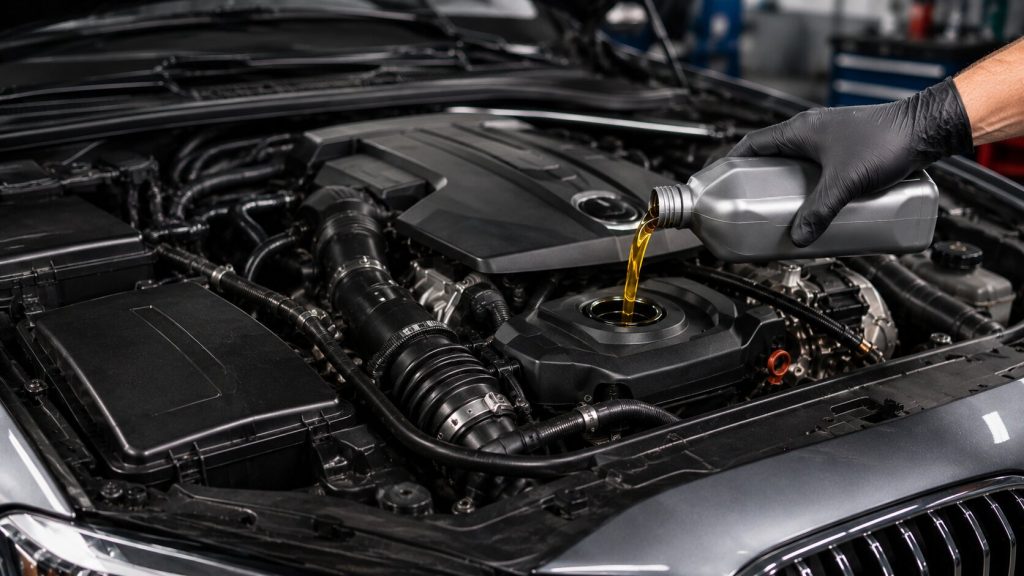
Modern European engines often require oils that meet specific manufacturer approvals, not simply a viscosity such as 0W-20 or 5W-30. These specifications establish performance requirements for characteristics such as wear protection, deposit control, oxidation resistance, and compatibility with engine and emissions systems. Using the correct manufacturer-specified oil helps ensure the lubricant performs as the engine was designed to require throughout its service interval.
Why Manufacturer Oil Specifications Matter
Engine oil has several jobs. It lubricates moving components, carries heat away from lubricated surfaces, suspends contaminants, helps control deposits, protects against corrosion, and serves as a hydraulic fluid for systems such as variable valve timing and timing chain tensioners.
Modern engines place significant demands on that oil. Turbochargers, direct fuel injection, variable valve timing, emissions equipment, and electronically controlled lubrication systems all influence the performance characteristics manufacturers require from a lubricant.
That is why manufacturers such as BMW, Mercedes-Benz, Porsche, Audi, and Volkswagen establish their own oil specifications for many vehicles. These specifications allow engineers to define how the lubricant needs to perform rather than relying on viscosity alone.
Oil Specification and Viscosity Are Not the Same Thing
A common misconception is that matching the viscosity printed on the oil cap or listed in the owner’s manual is enough to select the correct oil. It isn’t. Viscosity ratings such as 0W-20, 5W-30, and 5W-40 describe important characteristics of how an oil flows at different temperatures. They do not describe every performance characteristic of the finished lubricant.
- Two oils can both carry a 0W-20 viscosity rating while meeting very different manufacturer specifications.
- The viscosity printed on the bottle tells you how the oil flows. It does not tell you whether that oil meets all of the requirements established for your engine.
- The correct oil needs both an appropriate viscosity and the performance specification required for that particular application.
Understanding European Oil Approvals
BMW Longlife specifications, Mercedes-Benz MB-Approvals, Volkswagen/Audi VW standards, and Porsche oil specifications are examples of manufacturer-specific lubricant requirements. There is not one universal BMW, Mercedes-Benz, Audi, Volkswagen, or Porsche oil specification. The correct requirement can vary based on the engine, model year, market, and emissions equipment.
For that reason, seeing a familiar viscosity on the bottle does not necessarily mean the oil is appropriate for your vehicle. The manufacturer’s service information or owner’s manual should be used to determine the correct specification for the individual application.
Depending on the specification, oil performance requirements can include characteristics such as:
- Viscosity performance across a range of temperatures
- Wear protection
- Oxidation resistance
- Deposit and sludge control
- Oil volatility
- Fuel economy performance
- Compatibility with catalytic converters, particulate filters, and other emissions equipment
These requirements are what make manufacturer oil specifications meaningful. They establish how the finished lubricant needs to perform in the engine, not simply how thick or thin it is.
Why Driving Conditions Still Matter
A BMW that requires a particular BMW Longlife approval requires that exact specification whether it is driven on flat highways, through heavy traffic, or up steep mountain passes. The car’s engineering dictates the requirement, not its geographic location.
Driving conditions do, however, influence what happens to engine oil once it is in service:
- Frequent short trips can allow more moisture and volatile fuel to remain in the crankcase because the engine spends less time fully warmed up.
- Sustained heavy loads place the engine under greater stress for longer periods, increasing the thermal demands placed on the engine and its lubricating system.
- Cold starts, heavy traffic, accumulated mileage, and time in service all influence the environment in which the oil operates.
None of these conditions changes the manufacturer’s required oil specification. Instead, they help explain why using the correct oil and maintaining a responsible service interval both matter so much.
What Happens as Engine Oil Ages
Engine oil is designed to withstand demanding operating conditions, but it does not remain unchanged indefinitely. Time, temperature, contamination, and normal engine operation gradually affect the oil and consume the additives formulated into it.
- Oxidation can contribute to deposit and varnish formation.
- Fuel dilution can reduce viscosity over time.
- Moisture and combustion byproducts can accumulate, particularly when operating conditions prevent the engine from spending sufficient time fully warmed up.
Modern engines can be particularly sensitive to deposit formation because engine oil passes through relatively small passages used to operate components such as variable valve timing systems and turbochargers.
Using oil that meets the correct specification provides the performance characteristics the engine was designed around. Changing it at an appropriate interval removes accumulated contaminants and replaces depleted oil with a fresh lubricant package to support overall oil maintenance.
What Happens If the Wrong Oil Is Used
Using the wrong oil does not mean an engine will immediately suffer catastrophic damage. The concern is that an oil that does not meet the required specification may not provide all of the performance characteristics the manufacturer intended for that engine.
Depending on the application, an inappropriate lubricant can affect wear protection, deposit control, cold-start performance, hydraulic engine systems, emissions-system compatibility, or other aspects of engine operation.
This is also why choosing a supposedly “better” or thicker oil is not necessarily an improvement. A 5W-40 is not inherently better than a 5W-30, nor is a 0W-20 inherently too thin for a modern European engine. What matters is using the appropriate viscosity and specification for the particular engine.
Why I Recommend Regular Oil Service
Using the correct oil is only part of proper engine maintenance. It also needs to be changed at a responsible interval. I generally recommend engine oil service every 5,000 miles, with time also considered for vehicles that accumulate mileage slowly. Our goal is to protect the long-term condition of the engine rather than stretch out the maximum amount of time the oil can remain in service.
Regular oil service removes accumulated contaminants and replaces aging oil and its additive package. It also creates a valuable opportunity to check in on the condition of the rest of the vehicle.
More Than an Oil Change
A proper oil service is an important check-in on the overall condition of your vehicle, rather than simple drain and refill. I verify the appropriate oil specification for the vehicle, use the correct oil and filter, perform a thorough vehicle inspection, and scan the vehicle for stored faults and other information that may deserve attention.
A vehicle scan does not diagnose a mechanical problem by itself. It provides information our technicians can evaluate alongside the inspection, vehicle history, customer concerns, and their deep knowledge of European engineering. If something abnormal is identified, we can recommend the appropriate next diagnostic step rather than performing unnecessary testing or replacing parts based on assumptions.
Protect Your European Engine With the Correct Oil
Modern European engines are engineered around specific lubrication requirements. Proper maintenance means using more than an oil with the right number printed on the bottle. It means selecting an oil that meets the manufacturer’s required specification and replacing it at a responsible interval.
If your BMW, Audi, Volkswagen, Mercedes-Benz, Porsche, or other European vehicle is due for service, schedule an appointment at our shop at 1001 E 75th Ave, Unit A in Denver. I will make sure your vehicle receives the correct oil while using the service as an opportunity to check in on its overall condition.
Frequently Asked Questions
Does my European vehicle need synthetic oil?
Most modern European vehicles specify oils that are synthetic or formulated to meet demanding manufacturer performance requirements. Rather than choosing oil based solely on whether the bottle says “synthetic,” use an oil that meets the specific manufacturer approval and viscosity required for your engine.
Is using the correct oil viscosity enough?
No. Viscosity is only one part of selecting the correct engine oil. Two oils can have the same viscosity rating while meeting different performance specifications. The oil should meet both the appropriate viscosity requirement and the manufacturer specification for your particular engine.
How often should I change the oil in my European vehicle?
I recommend an oil service every 5,000 miles, with time also considered for vehicles that accumulate mileage slowly. We consider this a responsible maintenance interval for protecting the long-term condition of modern European engines.
What happens if I use oil that doesn’t meet the manufacturer specification?
Using an incorrect oil once does not mean your engine will immediately be damaged. However, repeatedly using a lubricant that does not meet the required specification can compromise characteristics such as wear protection, deposit control, viscosity performance, and emissions-system compatibility. Using the correct specification ensures the engine receives the lubricant performance it was designed around.